Showing posts with label concerts. Show all posts

Saturday, August 02, 2008


I played in an orchestra last week for Debbie Reynolds. She had a good rapport with the audience and they really enjoyed the show. She talked about how her first husband left her (with two young children) for Elizabeth Taylor, and her second and third husbands left her in great financial difficulty. Yet, she laughed about it, and using her self-deprecating humor, she got the audience to laugh along with her.

I took a gander at her website when I got home, and found this quote:

This writer acknowledges there was no intent to mention all of Debbie's starring roles, or her myriad of awards. The foregoing is rather the story of a woman whose solution to adversity is not to merely survive, but to constantly revive, renew, and live life to the maximum.

This isn't the gospel according to Debbie Reynolds. She didn't give any clues that she is a believer. But, since we don't seem to be able to pass through this world without being embraced by adversity, the quote got me to thinking. I agree that we should do more than merely survive. We must rely on the Lord for everything and rejoice for His sustenance. Today I feel like that sums up a Christian walk.

Sunday, May 20, 2007

Haydn's Farewell Symphony


"Be good and industrious, and serve God continually."

Franz Joseph Haydn (1732-1809)


I played Haydn's Farewell Symphony recently and began thinking of the first time it was performed (a dangerous thing to do when you're trying to transpose). When the piece was originally played, it was conducted by Haydn himself, wearing a powdered wig (part of his contract). His musicians (men only, in those days) performed standing up, playing by candlelight.

Haydn was employed for nearly thirty years by Prince Esterhazy, a very rich and influential Hungarian. Haydn and his chamber group went with Esterhazy to his summer palace annually, in order to entertain the prince. In the summer of 1772, Esterhazy kept his musicians beyond the original agreed upon date. The musicians missed their families and wanted desperately to return home, so Haydn composed his Symphony #45 The Farewell with a not so subtle hint. The fourth movement calls for each musician to play a little farewell melody, snuff out his candle, gather his score and instrument, and walk off the floor. Prince Esterhazy's chamber orchestra slowly dwindles until only two violins are left. The prince got the message, and the very next day, finally ordered his musicians to return home.

During Haydn's time, music belonged chiefly to the nobility and there was little in the way of public concerts. Compare that to our lives now. We have access to the greatest of classical music via radio, CDs, and concerts. Here I was, a woman (wearing pants!), playing a piece that premiered 235 years ago. Our audience was populated by "common" people who were able to attend for free (sponsored by a church and funded, in part, from tax monies for the arts). It felt quite strange when it came my time to leave the stage. But, as I thought back to my counterpart who did so for the first time in 1772, I enjoyed my little connection to history.

Wednesday, March 28, 2007

Sir Edward Elgar, My Dad, and Me


Last Saturday evening I got to perform Edward Elgar's symphonic work, Enigma Variations, for only the second time in my life. It's a lovely piece introduced by a short theme, followed by 14 musical variations, all based upon family members or close friends of Elgar's. Each variation, save one, has initials or a name to identify its human inspiration. My favorite variation has to be the one entitled "Nimrod," and Saturday I played it with tears trickling down my face.

When I was in 6th grade, my elementary school music teacher had me start working on the slow movement of Mozart's Third Horn Concerto. My father, also a music teacher, believed that I couldn't properly play such a piece because I was too young to understand its deep meaning, and requested that I not play it yet.

I don't know what my dad thought about me playing the Elgar piece when I was only fifteen, but I fell in love with it then, and I love it still. Perhaps I was too young to give the very emotional "Nimrod" variation its full due. But I think back to what I had experienced in my life at that time. Even at the tender age of fifteen, I had experienced several significant events of both sadness and joy. Thirty-six years later, I have certainly lived many more joys and disappointments, enabling me to play the variation with more pathos, but the music is so beautiful and universal, I think it can be appreciated by people of all ages.

Why was I crying? I cried because the last time I played the piece, my dad sat in on both the rehearsals and the final performance. This time, my dad is gone and I don't know where he's spending eternity. I cried because I didn't get to call him and tell him how good the concert was. I cried because this time I played the Elgar, my daughter was in the concert hall, and I want so very much to be a good mother to her and our son. I cried because the piece was so beautiful. The fact that good composers can dream up such beauty and commit it to paper for others to play for years after they are gone is truly a miracle.

Thank you, Lord, for imperfect parents, for great composers, and for ears and hearts to experience beautiful music.

Saturday, March 18, 2006

Leningrad Revisited


Nearly 42 years ago I sat with my father in the Colorado high school band room where he was the band director. My father and I, looking for a musical instrument for me to learn. I tried several instruments until I finally settled on the French Horn as "the one" I was to pursue. One month later we moved to another town and I began playing the French Horn. Shortly thereafter I first heard Shostakovich's Leningrad Symphony in our living room, listening to the record with my dad many times. He loved this symphony, and I grew to love it with him. Our family moved to West Virginia where I attended junior and senior high school, but I came back out to Colorado to attend college, where I played French Horn in the Greeley Philharmonic for two years and met the man whom I would later marry.

One week ago this evening, I got to perform the one symphony I most remember listening to with my dad, in the town where I had learned to play the horn. This is amazing considering I lived in nine different houses in three states before I left home for college. I had the wonderful privilege to perform this symphony with the Greeley Philharmonic Orchestra under the direction of Dr. Howard Skinner, under whose baton I sat in my college days. My husband of 25 years was in the horn section with me.

We played the "invasion theme" of the first movement, which I remembered so distinctly from my childhood. I was playing as loudly as I could, along with all of the orchestra, emulating the cacophony of the invading German army into Russia in 1941. But it was the closing strains of the fourth movement, the movement inspired by the hope that the Allies would eventually win the war, that brought tears to my eyes.

Dad died almost two years ago. But as I played those closing bars, the whole orchestra playing a joyous, victorious fortissimo, I gave it my all for my dad. My dad, who patiently sat in a band room while I tried out different instruments those many summers ago. I'm sure he would have found a way to be in the audience had he been alive. He would have been so proud. His "Little Bird" playing the very symphony we loved. I gave it my all and played for him.

Friday, March 17, 2006

Leningrad Symphony


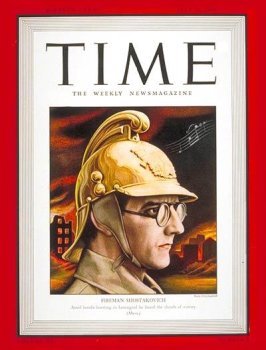
This past Saturday evening I had the pleasure to perform Dmitri Shostakovich's Symphony Number 7, "The Leningrad Symphony." I played the final measures of this 85 minute symphony with tears in my eyes and enjoyed every minute of it. There are conflicting books and articles written about Shostakovich, so I won't go into too much detail about him or this symphony here. But, I will try to explain this Time Magazine cover by sharing an excerpt of an interesting article.

"The start of the Great Patriotic War [1941, when Germany invaded Russia] stirred Shostakovich as it did millions of his countrymen. He tried twice to enlist in the Red Army but was turned down because of his poor eyesight. He then joined a Home Guard unit drawn from members of the Leningrad Conservatory (where Shostakovich taught), and the world-famous composer spent several weeks laboring to build defensive lines that Soviet military leaders were belatedly erecting around the city.

Shostakovich was next transferred to a firefighting brigade, where he was posted to extinguish any incendiaries that might land on the conservatory's roof. This assignment proved largely symbolic, as the school's directors always found excuses to keep their most valuable faculty member busy elsewhere.

Nonetheless, on July 29, 1941, Soviet propagandists posed fireman Shostakovich for a number of photos that were widely distributed and which came to symbolize the unshakable determination of Leningrad's defenders."

Go here to read the article in its entirety. (See also my previous post about Beethoven's Ninth Symphony.)