Showing posts with label favorite composers. Show all posts

Monday, August 10, 2009

Chant and Time


I'm listening to "How Lovely Is Thy Dwelling Place" from the German Requiem by Johannes Brahms (1833-1897). It nearly moves me to uncontrollable tears each time I hear it, so beautiful is the writing. So, while I wouldn't want a diet of only Gregorian Chant, I do enjoy listening to the sisters of the abbey sing.

This excerpt from Music of Silence helps me understand why. Author David Steindl-Rast, a Benedictine monk, strives to show how to "incorporate the sacred meaning of monastic life into our everyday lives."

Saturated with information but often bereft of meaning, we feel caught in a never-ending swirl of duties and demands, things to finish, things to put right. Yet as we dart anxiously from one activity to the next, we sense that there is more to life than our worldly agendas.

Our uneasiness and our frantic scrambling are caused by our distorted sense of time, which seems to be continually running out. Western culture reinforces this misconception of time as a limited commodity: We are always meeting deadlines; we are always short on time, we are always running out of time.

Chant music, on the other hand, evokes a different relationship to time, one in which time, while precious, isn't scarce. The pure, serene, yet soaring sounds of the chant remind us that there is another way to live in this noisy, distracted world, and this way is not as out of reach as it might seem.

Sunday, September 14, 2008

"O God, Beyond All Praising"


Check out today's broadcast of Sing for Joy.
The first hymn, Praise to the Lord, is a very nice choral arrangement. The final hymn, "O God, Beyond All Praising", is a new one to me. It is set to the tune of a movement from Gustav Holst's The Planets, which nearly always brings me to the verge of tears. Go here to listen to the melody and sing along with the words.


"O God Beyond All Praising"

O God beyond all praising,
we worship you today
and sing the love amazing
that songs cannot repay.

Holst grew up in the church pictured above and sang in the choir. (All Saints, Cheltenham, England)

Sunday, April 20, 2008

I Vow to Thee, My Country


British composer, Gustav Holst (1874-1934), has been on my mind this past week. He is probably best known for his orchestral composition, The Planets. Holst was one of my dad's favorite composers, due to his two Suites for band. I was privileged to play one of those this past Friday. The writing is just wonderful and it was a nice thing to do to commemorate my dad's birthday week.

I found this hymn, put to a melody from The Planets. It seemed appropriate for my past week of thinking of my dad and Holst. And, too, the words are very appropriate for James. He is the young man from Iowa who was killed in Afghanistan in 2004. His community had a motorcycle ride today to commemorate his life. They followed it with a visit to the cemetery and a chili supper. The event raises money for a scholarship fund in James's name. The words of this hymn seem appropriate for this event, as well.

(This hymn was also a favorite of Princess Diana's. It was sung at both her wedding and her funeral.)

May God continue to comfort James's family in the loss of their son, brother, uncle.


I Vow to Thee, My Country


I vow to thee, my country—all earthly things above—
Entire and whole and perfect, the service of my love;
The love that asks no question, the love that stands the test,
That lays upon the altar the dearest and the best;
The love that never falters, the love that pays the price,
The love that makes undaunted the final sacrifice.

And there’s another country, I’ve heard of long ago—
Most dear to them that love her, most great to them that know;
We may not count her armies, we may not see her King;
Her fortress is a faithful heart, her pride is suffering;
And soul by soul and silently her shining bounds increase,
And her ways are ways of gentleness, and all her paths are peace.

Sunday, March 23, 2008

He Is Risen


I stayed home from church today, to be with our dog, who had surgery on Friday. After reading the Resurrection story in my Bible, I listened to our classical radio station and got to hear lots of wonderful Bach music. Here is a snippet of Bach's Easter Oratorio.

(Remember to silence the music on the sidebar to the right before listening to the Bach piece.)

Bach's Easter Oratorio

Sunday, February 24, 2008

"O Lord, Make Haste to Hear My Cry"


This hymn is in honor of its composer, George Frederick Handel, born February 23, 1685. (Which is, by the way, the same year J.S. Bach was born.) To see additional verses and hear the melody, go to the link below.

"O Lord, Make Haste to Hear My Cry"

O Lord, make haste to hear my cry,
To Thee I call, on Thee rely.
Incline to me a gracious ear,
And, when I call, in mercy hear.

When in the morning unto Thee
I lift my voice and bring my plea,
Then let my prayer as incense rise
To God enthroned above the skies.

When unto Thee I look and pray
With lifted hands at close of day,
Then as the evening sacrifice
Let my request accepted rise.

Saturday, September 08, 2007

Vincero!

Opera fans can debate all they want about who was the better tenor of this age. Either way, the world has lost a beautiful voice. I can't listen to Pavarotti sing Puccini's Nessun dorma from Turandot without getting a tear in my eye and a lump in my throat. Puccini always does that to me.

To listen to the clip in the post directly below, you have to silence the music that's already playing on my blog (scroll down on the right and click on the left button of the Sonific box).


Dilegua, o notte! Tramontate, stelle!
Tramontate, stelle! All'alba vincero!
Vincero! Vincero!


Depart, oh night! Set, you stars!
Set, you stars! At dawn I shall win!
I shall win! I shall win!

from Nessun dorma

Sunday, May 20, 2007

Haydn's Farewell Symphony


"Be good and industrious, and serve God continually."

Franz Joseph Haydn (1732-1809)


I played Haydn's Farewell Symphony recently and began thinking of the first time it was performed (a dangerous thing to do when you're trying to transpose). When the piece was originally played, it was conducted by Haydn himself, wearing a powdered wig (part of his contract). His musicians (men only, in those days) performed standing up, playing by candlelight.

Haydn was employed for nearly thirty years by Prince Esterhazy, a very rich and influential Hungarian. Haydn and his chamber group went with Esterhazy to his summer palace annually, in order to entertain the prince. In the summer of 1772, Esterhazy kept his musicians beyond the original agreed upon date. The musicians missed their families and wanted desperately to return home, so Haydn composed his Symphony #45 The Farewell with a not so subtle hint. The fourth movement calls for each musician to play a little farewell melody, snuff out his candle, gather his score and instrument, and walk off the floor. Prince Esterhazy's chamber orchestra slowly dwindles until only two violins are left. The prince got the message, and the very next day, finally ordered his musicians to return home.

During Haydn's time, music belonged chiefly to the nobility and there was little in the way of public concerts. Compare that to our lives now. We have access to the greatest of classical music via radio, CDs, and concerts. Here I was, a woman (wearing pants!), playing a piece that premiered 235 years ago. Our audience was populated by "common" people who were able to attend for free (sponsored by a church and funded, in part, from tax monies for the arts). It felt quite strange when it came my time to leave the stage. But, as I thought back to my counterpart who did so for the first time in 1772, I enjoyed my little connection to history.

Wednesday, March 28, 2007

Sir Edward Elgar, My Dad, and Me


Last Saturday evening I got to perform Edward Elgar's symphonic work, Enigma Variations, for only the second time in my life. It's a lovely piece introduced by a short theme, followed by 14 musical variations, all based upon family members or close friends of Elgar's. Each variation, save one, has initials or a name to identify its human inspiration. My favorite variation has to be the one entitled "Nimrod," and Saturday I played it with tears trickling down my face.

When I was in 6th grade, my elementary school music teacher had me start working on the slow movement of Mozart's Third Horn Concerto. My father, also a music teacher, believed that I couldn't properly play such a piece because I was too young to understand its deep meaning, and requested that I not play it yet.

I don't know what my dad thought about me playing the Elgar piece when I was only fifteen, but I fell in love with it then, and I love it still. Perhaps I was too young to give the very emotional "Nimrod" variation its full due. But I think back to what I had experienced in my life at that time. Even at the tender age of fifteen, I had experienced several significant events of both sadness and joy. Thirty-six years later, I have certainly lived many more joys and disappointments, enabling me to play the variation with more pathos, but the music is so beautiful and universal, I think it can be appreciated by people of all ages.

Why was I crying? I cried because the last time I played the piece, my dad sat in on both the rehearsals and the final performance. This time, my dad is gone and I don't know where he's spending eternity. I cried because I didn't get to call him and tell him how good the concert was. I cried because this time I played the Elgar, my daughter was in the concert hall, and I want so very much to be a good mother to her and our son. I cried because the piece was so beautiful. The fact that good composers can dream up such beauty and commit it to paper for others to play for years after they are gone is truly a miracle.

Thank you, Lord, for imperfect parents, for great composers, and for ears and hearts to experience beautiful music.

Friday, March 23, 2007

Mrs. Edward Elgar


I am playing a concert tomorrow evening which includes a favorite piece of mine by British composer Edward Elgar (1857-1934). Although he's not a household name, most every adult can hum one of his most famous pieces, Pomp and Circumstance March No. 1. Otherwise known as the music that gets played over and over at graduations.


In reading about his life, I ran across this little bit about his wife in this article. Oh, that I could be such a blessing to MY husband!

In 1920, Lady Elgar died and with her died much of Elgar's inspiration and will to compose. She had organised his household and ministered to his comforts. For a long time she saved him hours of drudgery, for instance by ruling bar lines on score paper. She walked miles in all weathers to post precious parcels of manuscript and proofs. In the early days of their marriage she had collaborated with him to produce such works as Scenes from the Bavarian Highlands (1896) - Elgar's settings of his wife's poems inspired by holidays spent in Germany. At times when success seemed forever to be eluding him, she never lost faith. In short, she had been the driving force behind his genius encouraging him and proclaiming his talents at every opportunity.


Interestingly, her family had discouraged her from marrying the man who was beneath her. Elgar, the son of a tradesman and a lowly music teacher "without prospects," wasn't good enough for their girl. He eventually became one of Britain's most loved composers and was knighted for his accomplishments.

Thank you, Lord, for Caroline Alice Roberts Elgar, who provides us with an example of a woman who had faith in her husband and played a vital role in his life and career.

Sunday, February 11, 2007

"Blessed Jesus at Thy Word"


We sang this hymn preceeding today's Gospel reading (Luke 6:17-26). The words were written in 1663 by German pastor Tobias Clausnitzer (1619-1684). The music was written by German church organist Johann Rudolf Ahle (1625-1673) in 1664.

Clausnitzer preached in Leipzig's famous St. Thomas Church (pictured at left) early in his pastorate. Originally built as part of a 12th-century monastery, Thomaskirche is now a Lutheran church. Martin Luther preached here in 1539 (more than 100 years before Clausnitzer), formally bringing the Reformation to Leipzig. Later, Johann Sebastian Bach was the choirmaster here for 27 years, beginning in 1723 and continuing until his death in 1750. Most of Bach's cantatas were written for the church's famous boys' choir, founded in the 13th century. Twelve of Bach's children were baptized at Thomaskirche, as was composer Richard Wagner in 1813. Both Mozart and Mendelssohn performed here, as well.

Click on the hymn title below to hear the melody.

"Blessed Jesus at Thy Word"

Blessèd Jesus, at Thy Word
We are gathered all to hear Thee;
Let our hearts and souls be stirred
Now to seek and love and fear Thee,
By Thy teachings sweet and holy,
Drawn from earth to love Thee solely.

All our knowledge, sense and sight
Lie in deepest darkness shrouded,
Til Thy Spirit breaks our night
With the beams of truth unclouded.
Thou alone to God canst win us;
Thou must work all good within us.

Glorious Lord, Thyself impart!
Light of light, from God proceeding,
Open Thou our ears and heart;
Help us by Thy Spirit’s pleading;
Hear the cry Thy people raises;
Hear and bless our prayers and praises.

Father, Son, and Holy Ghost,
Praise to Thee and adoration!
Grant that we Thy Word may trust
And obtain true consolation
While we here below must wander.

Sunday, September 10, 2006

"Joyful, Joyful, We Adore Thee"


We sang this as our recessional hymn this morning in church. I can't listen to the stirringly beautiful melody without remembering my favorite Beethoven story. I urge you again to listen to one of Beethoven's symphonies this week. The melody in this hymn comes from the final movement of his Ninth Symphony, but any of them would be wonderful to listen to.


"Joyful, Joyful, We Adore Thee"
Joyful, joyful, we adore Thee, God of glory, Lord of love;
Hearts unfold like flowers before Thee, opening to the sun above.
Melt the clouds of sin and sadness; drive the dark of doubt away;
Giver of immortal gladness, fill us with the light of day!

All Thy works with joy surround Thee, earth and heaven reflect Thy rays,
Stars and angels sing around Thee, center of unbroken praise.
Field and forest, vale and mountain, flowery meadow, flashing sea,
Singing bird and flowing fountain call us to rejoice in Thee.

Thou art giving and forgiving, ever blessing, ever blessed,
Wellspring of the joy of living, ocean depth of happy rest!
Thou our Father, Christ our Brother, all who live in love are Thine;
Teach us how to love each other, lift us to the joy divine.

Mortals, join the happy chorus, which the morning stars began;
Father love is reigning o’er us, brother love binds man to man.
Ever singing, march we onward, victors in the midst of strife,
Joyful music leads us Sunward in the triumph song of life.

Saturday, March 18, 2006

Leningrad Revisited


Nearly 42 years ago I sat with my father in the Colorado high school band room where he was the band director. My father and I, looking for a musical instrument for me to learn. I tried several instruments until I finally settled on the French Horn as "the one" I was to pursue. One month later we moved to another town and I began playing the French Horn. Shortly thereafter I first heard Shostakovich's Leningrad Symphony in our living room, listening to the record with my dad many times. He loved this symphony, and I grew to love it with him. Our family moved to West Virginia where I attended junior and senior high school, but I came back out to Colorado to attend college, where I played French Horn in the Greeley Philharmonic for two years and met the man whom I would later marry.

One week ago this evening, I got to perform the one symphony I most remember listening to with my dad, in the town where I had learned to play the horn. This is amazing considering I lived in nine different houses in three states before I left home for college. I had the wonderful privilege to perform this symphony with the Greeley Philharmonic Orchestra under the direction of Dr. Howard Skinner, under whose baton I sat in my college days. My husband of 25 years was in the horn section with me.

We played the "invasion theme" of the first movement, which I remembered so distinctly from my childhood. I was playing as loudly as I could, along with all of the orchestra, emulating the cacophony of the invading German army into Russia in 1941. But it was the closing strains of the fourth movement, the movement inspired by the hope that the Allies would eventually win the war, that brought tears to my eyes.

Dad died almost two years ago. But as I played those closing bars, the whole orchestra playing a joyous, victorious fortissimo, I gave it my all for my dad. My dad, who patiently sat in a band room while I tried out different instruments those many summers ago. I'm sure he would have found a way to be in the audience had he been alive. He would have been so proud. His "Little Bird" playing the very symphony we loved. I gave it my all and played for him.

Friday, March 17, 2006

Leningrad Symphony


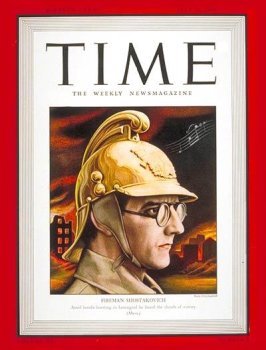
This past Saturday evening I had the pleasure to perform Dmitri Shostakovich's Symphony Number 7, "The Leningrad Symphony." I played the final measures of this 85 minute symphony with tears in my eyes and enjoyed every minute of it. There are conflicting books and articles written about Shostakovich, so I won't go into too much detail about him or this symphony here. But, I will try to explain this Time Magazine cover by sharing an excerpt of an interesting article.

"The start of the Great Patriotic War [1941, when Germany invaded Russia] stirred Shostakovich as it did millions of his countrymen. He tried twice to enlist in the Red Army but was turned down because of his poor eyesight. He then joined a Home Guard unit drawn from members of the Leningrad Conservatory (where Shostakovich taught), and the world-famous composer spent several weeks laboring to build defensive lines that Soviet military leaders were belatedly erecting around the city.

Shostakovich was next transferred to a firefighting brigade, where he was posted to extinguish any incendiaries that might land on the conservatory's roof. This assignment proved largely symbolic, as the school's directors always found excuses to keep their most valuable faculty member busy elsewhere.

Nonetheless, on July 29, 1941, Soviet propagandists posed fireman Shostakovich for a number of photos that were widely distributed and which came to symbolize the unshakable determination of Leningrad's defenders."

Go here to read the article in its entirety. (See also my previous post about Beethoven's Ninth Symphony.)

Monday, March 13, 2006

The Many Layers of a Symphony


A symphony is not just a symphony. Symphonic works are wonders to behold; great masterpieces composed by the geniuses of their day. Take Beethoven's Ninth Symphony for example. It is an absolute marvel of a composition. And yet, if you look at the story behind the symphony you will appreciate it all the more. By the time Beethoven composed the Ninth, he was completely deaf. The piece is magnificent enough, but when you realize this limitation, you will never listen to it in quite the same way again. I would be hard pressed to compose two minutes of an original composition for one instrument. Beethoven composed a four movement symphony, for orchestra and chorus, that lasts 59 minutes and 43 seconds!

In addition to this marvel, Beethoven got to conduct his own piece at its premier. I wonder what it must have felt like, standing on the podium, "hearing" the entire symphony in his head as he conducted the orchestra. When the last strains of the joyous fourth movement died away and Beethoven put down his baton, he didn't know what the reaction of the audience would be to this new symphony of his. The orchestra members had to motion to Beethoven to turn around and face the audience. As he did so, he saw them standing, clapping, and cheering for his wonderful masterpiece.

I urge you to take some time this week to listen to one of Beethoven's nine symphonies. These are just a part of the entire body of his work, but they certainly deserve to be placed in the category of "classics." That one man could compose so much beautiful music, be such a musical innovator in his day, and compose once he had become totally deaf are all marvels that only God could enable to come to fruition.